
Resistance Meters
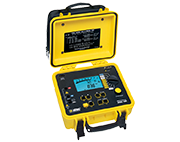
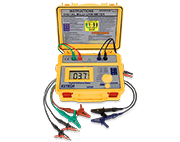
A resistance meter, or ohmmeter, is a testing instrument that measures electrical resistance. Most ohmmeters are digital devices, although analog variants are available for measuring rapidly fluctuating values.
Ohmmeters work by passing a constant current through the resistance, with a second circuit that measures voltage across that resistance. A microcontroller or microprocessor then uses Ohm's Law to divide the voltage by the current and display the resulting resistance value to the user.
Resistance meters are suitable for a huge variety of applications, from circuit testing on boards or small electronic devices, to insulation testing on motors, transformers, or other heavy machinery.
Types of Resistance Meters
Resistance meters support troubleshooting and verification tasks where resistance readings are critical. They are used when resolution and repeatability are important for the measurement workflow.
- Resistance meters designed for general resistance measurement checks.
- Models intended for applications requiring improved resolution and repeatability.
- Tools selected for routine verification workflows and consistent measurements.
For broader electrical measurements beyond resistance, compare multimeters. For quick verification checks without detailed measurements, compare electrical testers.
Key Selection Criteria for Resistance Meters
- Measurement range and resolution aligned with the application.
- Accuracy and repeatability requirements.
- Connection method and ease of obtaining stable readings.
- Portability and durability for field work.
- Any needs for recording or documenting results.
Selecting a resistance meter matched to the measurement need supports clearer troubleshooting and more consistent verification.
Frequently Asked Questions
When should I use a resistance meter instead of a multimeter?
Use a resistance meter when resistance measurement is the primary requirement and when higher resolution or repeatability is important to the workflow. Use a multimeter for broader electrical measurements.
What specifications matter most for resistance measurement?
Focus on measurement range, resolution, accuracy, and repeatability. Then consider ease of connection and usability based on how the measurement is performed. For general electrical verification tools, compare test equipment.
How do I choose the right range and resolution?
Start with the expected resistance values in your application, then select a range that covers those values and a resolution that supports the level of detail you need. If you also document electrical behavior over time, compare power monitoring.
