
Light Meters
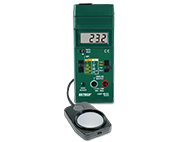
A light meter is a test device used to measure the amount of ambient light present in an environment. The light measurement is expressed in foot-candles or lux, which are the non-SI and SI units of illuminance cast on a surface by a light source.
Light meters are commonly used to increase the energy efficiency of an interior lighting system. A photoelectric sensor measures the amount of light in a room, and designers can adjust the output of luminaires to suit the environment.
Light meters offer a great deal of flexibility and accuracy, depending on the model. Testers can measure luminance up to 999,900 lux with a resolution up to 0.1 lux. They are accurate within 3 to 5 percent at distances up to several meters.
Types of Light Meters
Light meters are used to measure illumination levels for facility assessments, workspace checks, and process environments where lighting conditions matter. They support consistent measurements across locations and time.
- Portable light meters for walk-through checks and quick readings.
- Light meters designed for repeatable measurement routines and documentation.
- Models that support broader facility assessment workflows.
For broader facility checks, teams may also use sound meters for noise assessments and thermometers for temperature verification.
Key Selection Criteria for Light Meters
- Measurement range and accuracy requirements.
- Sensor behavior and response time for your environment.
- Ease of use and readability in typical lighting conditions.
- Portability and durability for field work.
- Data logging or reporting needs for documentation.
Selecting a meter that matches the environment and workflow helps support consistent lighting verification.
Frequently Asked Questions
When are light meters used in industrial settings?
Light meters are used for workspace and facility lighting checks, especially when consistent illumination supports safety, productivity, or process requirements. For related safety/environment assessments, compare sound meters.
What should I compare when choosing a light meter?
Compare measurement range and accuracy first, then consider usability factors like readability, portability, and whether the meter supports repeatable documentation. For repeatable documentation across multiple parameters, some workflows may also involve data acquisition.
Do I need data logging for lighting checks?
Data logging can be helpful if you document lighting conditions over time or across multiple locations. For quick checks, a basic meter may be sufficient. For broader facility monitoring and logging, compare power monitoring or data acquisition depending on what you're tracking.
