
Tachometers
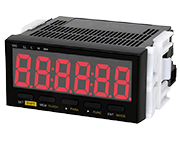
Tachometers for RPM Measurement and Rotational Speed Monitoring
Tachometers are used to measure the rotational speed of shafts, motors, disks, and other rotating machinery. They provide speed readings commonly expressed in revolutions per minute, helping operators verify equipment performance, diagnose mechanical issues, and maintain proper operating conditions in industrial systems.
In practical applications, tachometers are used on motors, conveyors, fans, pumps, generators, machine tools, and other rotating equipment where speed monitoring is important. Contact tachometers measure speed through direct connection to a rotating shaft, while non-contact tachometers use optical, laser, or magnetic sensing methods to measure rotation without physical contact. For equipment panels and continuous monitoring applications, panel mount tachometers provide fixed display and monitoring capability directly within a control panel or machine interface.
Tachometers are often selected based on the speed range, sensing method, display type, and installation requirements. Handheld models are useful for maintenance checks and troubleshooting, while panel-mounted units are better suited for continuous speed indication in production equipment, motor control systems, and process machinery. Depending on the application, tachometers may also be used with proximity sensors, encoders, or other process and instrumentation devices to provide reliable feedback for monitoring or control.
When selecting a tachometer, key considerations include RPM range, measurement accuracy, response time, input signal type, mounting style, and environmental conditions. For applications with low-speed rotation, pulse timing accuracy may be especially important. For high-speed machinery, frequency measurement capability and signal stability become critical. Proper tachometer selection helps ensure accurate speed measurement, improved equipment monitoring, and better maintenance decision-making.
Frequently Asked Questions
What factors affect tachometer accuracy?
Accuracy can be affected by sensor alignment, target visibility, signal noise, vibration, improper scaling, unstable inputs, and incorrect configuration. Correct installation and setup are important for reliable speed measurement.
How do I scale a tachometer for accurate RPM display?
Scaling requires setting the correct pulses per revolution, input type, and display range. The tachometer must be configured so the incoming sensor pulses accurately correspond to the mechanical rotation being measured.
What causes unstable tachometer readings?
Unstable readings can be caused by poor sensor alignment, weak signal input, vibration, electrical noise, incorrect scaling, or inconsistent target detection. Checking sensor placement and signal quality usually resolves the issue.