
Thermoelectric Coolers
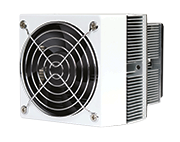
Thermoelectric Coolers for Enclosure and Equipment Temperature Control
Thermoelectric coolers are solid-state thermal management devices that use the Peltier effect to transfer heat from one side of the assembly to the other. They provide precise, reliable cooling without moving parts, refrigerants, or compressors, making them suitable for electrical enclosures, control cabinets, and industrial equipment where vibration, moisture, or maintenance concerns are critical.
Thermoelectric coolers are commonly used in enclosure climate control systems in conjunction with other components such as air conditioners, fans and enclosure heaters to manage heat load and prevent condensation. They are particularly useful when traditional cooling methods are impractical due to environmental sensitivity or equipment constraints.
Thermoelectric coolers can also be paired with environmental control devices such as thermostats to regulate activation based on internal temperature, and hygrostats to help control humidity when condensation risk is a concern.
Because they do not rely on compressors or refrigerants, thermoelectric coolers deliver quiet operation, reduced maintenance, and long service life. They are often chosen for electronic equipment cooling, lab instrumentation housings, communication cabinets, and other enclosed systems where precise temperature control is essential.
Frequently Asked Questions
How do thermoelectric coolers work in enclosure applications?
Thermoelectric coolers use the Peltier effect to move heat from the inside of an enclosure to the outside when an electrical current is applied. This solid-state process allows precise temperature control without compressors, refrigerants, or moving parts.
When should a thermoelectric cooler be used instead of an air conditioner?
Thermoelectric coolers are ideal for small to medium enclosures with modest heat loads, especially where vibration, maintenance concerns, or environmental sealing make traditional air conditioners impractical. They are commonly used in sensitive electronic and control applications.
Do thermoelectric coolers require internal airflow?
Yes, internal airflow is important to ensure heat is evenly transferred away from heat-generating components. Many thermoelectric cooling systems are used alongside internal circulation fans to improve heat distribution within the enclosure.