
Resistors
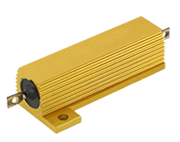
Resistors for Current Limiting, Voltage Division, and Signal Conditioning
Resistors are passive, two-terminal electrical components that introduce resistance into a circuit. They reduce current flow, adjust signals, and divide voltages, and they dissipate electrical power as heat. Resistance is measured in ohms (Ω) according to Ohm's law, and most resistor selection starts with matching the resistance value and confirming the circuit conditions that affect heat and stability. For related component families, browse Electronic Components.
Resistors are ubiquitous in modern electronics and show up in nearly every electrical device, from controls and instrumentation to motor and power systems. Because their primary role is to limit current (and convert some of the energy to heat), the type, size, and materials used in a resistor can significantly affect its performance. Larger resistors can typically dissipate more power and withstand higher temperatures, which is important in high-energy applications. Smaller, precision-oriented designs often prioritize tighter tolerances and lower noise, making them a better fit for sensitive circuits that can drift or become unstable when component values vary.
To reduce confusion, it helps to think in terms of "what problem is the resistor solving." General-purpose resistors are used for basic current limiting and signal biasing, precision resistors are chosen when repeatability and stability matter, and power resistors are used when wattage and heat dominate the design. Many resistors are built into integrated circuits, but standalone options are still widely used for panel and circuit-board solutions, especially in automation and control applications where setpoints, signal conditioning, and protective behaviors need to be tuned.
Resistors also commonly "pair" with adjacent components. RC (resistor-capacitor) combinations are used for timing, filtering, and noise reduction via RC networks and capacitors. For transient protection, circuits may add metal oxide varistors (MOVs) to clamp voltage spikes, especially in industrial environments where switching events are common. If you need adjustability rather than a fixed resistance value, you are usually looking for potentiometers or rheostats.
- General-purpose resistors for basic current limiting, biasing, and signal control in everyday circuits
- Precision resistors when tighter tolerance and long-term stability matter for calibration, sensing, or low-noise signal paths
- Power resistors for higher-energy applications where heat dissipation and wattage are the main constraints
- Adjustable resistance: use potentiometers for adjustable voltage division and setpoints, or rheostats for adjustable current control in series circuits
- Timing, filtering, and noise reduction: pair resistors with RC networks and capacitors for smoothing, pulse shaping, and basic filtering behavior
- Surge and transient protection: add MOVs in spike-prone environments to help clamp transient voltage events alongside resistive/RC elements
Frequently Asked Questions
What does a resistor do in a circuit?
A resistor limits current, shapes signals, and helps divide voltages by adding a controlled amount of resistance (Ω) to a circuit. Because it dissipates power as heat, selecting the correct resistance value and power rating is essential for reliable performance.
Which specs matter most when selecting a resistor?
Most selections come down to resistance value (Ω), tolerance (%), and power rating (W). For circuits where stability matters, temperature behavior and noise performance can also be important. If the application requires adjustable resistance, it's often better to use potentiometers or rheostats rather than trying to "make" a fixed resistor adjustable.
Why does power rating (wattage) matter so much?
Resistors convert electrical energy into heat, so the wattage rating indicates how much power they can safely dissipate. Undersizing wattage can cause overheating, drift in resistance value, or failure, especially in systems with frequent switching or sustained load, including many automation and control environments.
How do resistors work with capacitors in RC circuits?
Resistors and capacitors are commonly paired to create timing and filtering behaviors (for example, smoothing a signal or reducing noise). If the design calls for a combined solution, RC networks can simplify selection, and related capacitors help tune the cutoff or timing behavior.
How do MOVs relate to resistors in industrial electronics?
MOVs are commonly used alongside resistors and RC components to help clamp transient voltage spikes. In environments with inductive loads or frequent switching, MOVs can reduce surge-related stress on sensitive electronics and improve overall circuit reliability.