
Potentiometers
Potentiometers for Manual Control, Calibration, and Voltage Division
Potentiometers are variable resistors with three terminals. Two terminals connect to the ends of a resistive element, and the third connects to a sliding contact (the "wiper") that moves across the element. As the wiper position changes, the output voltage changes, which is why potentiometers are commonly used as voltage dividers in electronics and industrial controls. For related components across the catalog, browse Electronic Components.
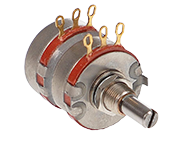
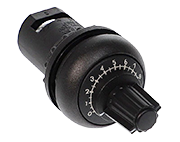
In industrial applications, potentiometers are often used to fine-tune how a circuit behaves, giving operators manual control over a setpoint such as speed, level, or output. You will commonly see them on control panels and operator stations as panel mount potentiometers, or paired with knobs, dials, and handles that make adjustment easier using potentiometer operators. In many systems, this type of manual adjustability complements broader automation and control functions by allowing quick on-the-fly tuning without changing the underlying control hardware.
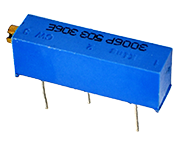
Another common use case is calibration and tuning, where the potentiometer is meant to be set once and left alone. These are typically trimmer potentiometers (often called trimpots), which are adjusted with a small tool such as a screwdriver. Trimpots are frequently used as presets in equipment to dial in thresholds, offsets, or reference voltages during setup, testing, or service.
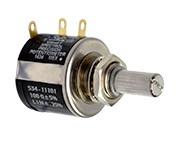
When precision and stability matter, precision potentiometers are used for higher resolution adjustments and repeatable settings. Across types, common selection factors include resistance value (ohms), taper (linear vs. logarithmic), power rating, environmental exposure (dust, moisture, vibration), and mounting style. Matching the potentiometer type to the adjustment method (operator control vs. calibration) is usually the fastest way to reduce confusion and get to the right product family.
- Panel mount potentiometers for operator-adjustable setpoints and controls
- Potentiometer operators (knobs, dials, handles) for easier adjustment and panel interface
- Trimmer potentiometers for calibration presets and "set-and-leave" tuning
- Precision potentiometers for high-resolution, repeatable adjustments
Frequently Asked Questions
What is the difference between a potentiometer and a variable resistor?
A potentiometer is designed to be used as a three-terminal device (often as a voltage divider), while a variable resistor is commonly used with two terminals to vary resistance in series with a load. Many products can be wired either way, but if you need an operator-adjustable setpoint, start with panel mount potentiometers and the appropriate operators.
What are trimpots used for in industrial equipment?
Trimmer potentiometers, trimpots, are commonly used as internal presets for calibration and tuning. They are often adjusted during setup, testing, or service to dial in thresholds, offsets, or reference voltages, then left unchanged during normal operation.
When should I use a precision potentiometer?
Use precision potentiometers when you need finer adjustment resolution, better repeatability, or more stable settings over time. They are a common fit for instrumentation, calibration fixtures, and applications where small changes in output need to be controlled predictably.
What are typical applications for panel mount potentiometers?
Panel mount potentiometers are frequently used for manual adjustments such as speed trims, output level control, setpoint tuning, and operator-controlled "fine adjust" functions. Pairing them with the right potentiometer operator can improve usability and reduce accidental setting changes.
Which specifications matter most when selecting a potentiometer?
Most selections come down to resistance value (ohms), taper (linear vs. logarithmic), power rating, and mounting style, plus environmental requirements such as sealing against dust or moisture. If the device is operator-facing, start with panel mount options; if it is intended as a preset, trimmer potentiometers are usually the better match.